When we put together the surprise 20th anniversary issue of Tangents Magazine, I intended it to be one last word on what that magazine was capable of. One more chance to have fun, shake some things up, and say, “We did this, and we’re proud of it.” To my surprise, many of you welcomed us back with open arms. You wrote us to ask when the next issue would be. You asked if you could buy ads in the next issue. When Tangents originally folded in the doldrums of 1998, I thought that someone would surely figure out the formula that the magazine had concocted, and create something to fill that void. Nearly 20 years on, it turns out that it was us all along that would pick up where we had left off. And so it goes…
With that in mind, I’m happy to announce that Tangents Magazine will return in 2016. We’re still working out how many issues we’ll do, but we are looking to return to the newsstands in the spring of 2016. Yes, I said newsstands. We’ll be posting new and archival issues at tangentsmag.com, but we will once again be print-based, in glorious high-end ‘zine quality. Just the way that you, and we like it.
All of that being said, this new era of Tangents needs you, in many ways. While many of us that oversaw Tangents back then wil be back onboard, the magazine has to be more than nostalgia to be relevant. Tangents was, and is a loose collective of people that wanted to create something different. Something that speaks to the collective experience of our lives, what we’re interested, and what makes us want to speak up. Be it now, or in the days to come.
So, if you would like to write, or contribute to Tangents, welcome. Email us at tangentsmag95@gmail.com, and feel free to send us articles, essays, poetry, ideas, or just general thoughts and outbursts. If you contributed to Tangents the first time around, welcome back. Email us, and let the conversation begin again. And if you would like to buy an ad in Tangents, email us. Because creativity and commerce can co-exist, if we allow it to do so.
Thanks for your time, and please check back soon for updates. The future is un-written, so let the story begin, all over again.
See you on the journey.
-Daniel
December 2, 2015
Showing posts with label 20th Anniverary Issue. Show all posts
Showing posts with label 20th Anniverary Issue. Show all posts
Wednesday, December 2, 2015

Monday, October 12, 2015
What's Next For Tangents
Hello All-
Thank you to all of you for responding to Tangents Magazine's 20th Anniversary Issue. Now, just when I thought that the issue would be the end of Tangents, we're contemplating the future. That begins with a project to collect, and publish Tangents' articles from the early days, and 2011 webzine.
If you were a part of Tangents, or had pieces published in Tangents, contact me at tangentsmag95@gmail.com. We would love to publish your work as part of the archive collection, and we can compensate you for your work. I'll keep you posted on this work, and I hope to have this out sometime in the new year.
You'll also notice that we have started to post original articles from the 1995 to 1998 era of Tangents. You'll also see some articles from the 2011 relapse. Do you have any favorites that you would like to see again? Let us know.
As for the future, beyond that? Stay tuned.
-Daniel
October 12, 2015
Thank you to all of you for responding to Tangents Magazine's 20th Anniversary Issue. Now, just when I thought that the issue would be the end of Tangents, we're contemplating the future. That begins with a project to collect, and publish Tangents' articles from the early days, and 2011 webzine.
If you were a part of Tangents, or had pieces published in Tangents, contact me at tangentsmag95@gmail.com. We would love to publish your work as part of the archive collection, and we can compensate you for your work. I'll keep you posted on this work, and I hope to have this out sometime in the new year.
You'll also notice that we have started to post original articles from the 1995 to 1998 era of Tangents. You'll also see some articles from the 2011 relapse. Do you have any favorites that you would like to see again? Let us know.
As for the future, beyond that? Stay tuned.
-Daniel
October 12, 2015
Monday, September 14, 2015
Back in the ’90s: The Charlotte music scene
by Daniel Coston
The way that many people viewed the Charlotte music scene was put in motion on September 18th of 1990, when GWAR performed at the 4808 Club. Local police arrested band frontman Dave Brockie and club owner Michael Plumides on obscenity charges. In statements given to the media after the arrests, the arresting officers made themselves and the city look like the prudish, backwards southern city that Charlotte was struggling to emerge from. There was also more to the arrest than just that night’s entertainment. It has since been suggested that the arrest was motivated by another club owner to remove his competition, and for the police to remove another music venue that they saw as a noisy nuisance. This event, along with other factors, kept many new and emerging artists from making stops in Charlotte. Despite this, the local music scene continued to thrive and find outlets as the decade pushed on.
Rock & Roll bands from Charlotte were already known to many as the decade began. Fetchin’ Bones, led by Hope Nicholls, had recorded three albums for Capitol Records before they broke up in 1990. The Spongetones saw their Beatlesque pop distributed by Sony Records in Japan. ANTiSEEN would carry their southern punk message throughout the world during the 1990s. Animal Bag would record two albums for Mercury Records and tour throughout the Southeast. Other bands that emerged from the Charlotte area during the first part of the decade included Thurn & Taxis, Hardsoul Poets, Blind Dates, Neglected Sheep, Kudzu Ganja, and many others.
Music venues in Charlotte kept changing throughout the decade. Local bands played at mainstays like the Double Door Inn and the Milestone Club. Many of the emerging Rock & Roll bands in town played places like the 4808 Club, the Pterodactyl Club, Jeremiah’s, and Amos’ (in its original location). Other smaller venues, such as Fat City, the Moon Room, and Jack Straw’s would also cater to local musicians. Larger venues, such as what was then the new Charlotte Coliseum, the old Coliseum (now known as Bojangles Coliseum), Ovens Auditorium, and Blockbuster Pavilion continued to draw national acts, but rarely featured local acts. There were also no music venues in the downtown area with the exception of Spirit Square. The venue featured touring theater and musical acts, such as Johnny Cash in 1994, and occasionally featured local musicians. The loss of festivals such as Springfest and Charlotte Jazzfest gave way to more regionalized festivals such as Center Cityfest.
During the 1990s, North Carolina’s music scene began to get more national notice. The rise of Chapel Hill’s alternative rock scene, and the emergence of record labels such as Merge Records and Mammoth Records, drew a lot of attention to the Triangle area of the state. By the mid-1990s, a number of Chapel Hill-based bands had songs on the radio. Ben Folds Five, Southern Culture On The Skids, Squirrel Nut Zippers and others showed one could be based out of North Carolina and hit the national charts. With that backdrop, a number of record labels came calling to Charlotte.
Sire Records alone signed three Charlotte bands during this time. This included Sugarsmack, led by former Fetchin’ Bones frontwoman Hope Nicholls, as well as Muscadine, which spawned future solo stars Jonathan Wilson and Benji Hughes. Jolene, which had emerged from Hardsoul Poets, also released one album on Sire, with their single “Pensacola” getting a good amount of national airplay. Also releasing major label albums during this time was Lustre, who formerly known as Shiner. Other groups such as Sound Of Mine, Spite, Come On Thunderchild, Sunny Ledford, Lou Ford, and Laburnum also received nationwide distribution through various record labels. The Charlotte music scene was especially strong during the mid-1990s, with bands such as Doubting Thomas, 2nd Skin (later known as Violet Strange), It Could Be Nothing, My So-Called Band, Peralta, X-Periment, Five Times Down, Poprocket, Major Nelson, Mercury Dime, David Childers, Gideon Smith, Draggin’ Flowers, Ublisch and others vying for listeners eager to hear the next new sound.
Despite the endless stream of bands in the Charlotte area during this time, it took longer for the city to provide the amount of venues necessary to support all of this music. Like many other music scenes, there was not always a lot of crossover with bands, and their various genres. Bands like ANTiSEEN and Spite might attract punk and metal fans to Tabloids, while rock and Americana fans might see their favorite bands at the Double Door Inn. If these bands played the same venues, such at Fat City or Tremont Music Hall, they rarely played together. For multi-genre acts such as X-Periment and Peralta, building up an audience took time. Much like the city itself, Charlotte’s music scene was just beginning to expand its views on where to go, and what was available to them. In time, the venues and audiences began to catch up to that need.
Clubs like the Pterodactyl gave way to venues such as the Baha Club and more underground venues like the Septic Tank. Some venues, like Tabloids, Cafe Dada, the Capri Theater, Atlantic Beer & Ice and others, came and went in a matter of a couple of years. New and larger venues for Rock & Roll music began to emerge, such as Tremont Music Hall when it opened in 1995. The Neighborhood Theater opened in 1997, utilizing a former movie theater that had originally opened in 1945. In another part of town the Visulite Theater, which had originally opened in 1939, opened as a music venue in 1999.
Looking back, the music scene in Charlotte during the 1990s had a lot to offer, and the quality of that music still holds up with any music scene during that time. The 1990s brought a lot of change and eventual growth to Charlotte, and the music reflected those times. With bands such as Hardsoul Poets and Fetchin Bones holding sellout reunion shows in recent years, the proof is there that people were listening to what was being created, and still care about it, all these years on.
The way that many people viewed the Charlotte music scene was put in motion on September 18th of 1990, when GWAR performed at the 4808 Club. Local police arrested band frontman Dave Brockie and club owner Michael Plumides on obscenity charges. In statements given to the media after the arrests, the arresting officers made themselves and the city look like the prudish, backwards southern city that Charlotte was struggling to emerge from. There was also more to the arrest than just that night’s entertainment. It has since been suggested that the arrest was motivated by another club owner to remove his competition, and for the police to remove another music venue that they saw as a noisy nuisance. This event, along with other factors, kept many new and emerging artists from making stops in Charlotte. Despite this, the local music scene continued to thrive and find outlets as the decade pushed on.
Rock & Roll bands from Charlotte were already known to many as the decade began. Fetchin’ Bones, led by Hope Nicholls, had recorded three albums for Capitol Records before they broke up in 1990. The Spongetones saw their Beatlesque pop distributed by Sony Records in Japan. ANTiSEEN would carry their southern punk message throughout the world during the 1990s. Animal Bag would record two albums for Mercury Records and tour throughout the Southeast. Other bands that emerged from the Charlotte area during the first part of the decade included Thurn & Taxis, Hardsoul Poets, Blind Dates, Neglected Sheep, Kudzu Ganja, and many others.
Music venues in Charlotte kept changing throughout the decade. Local bands played at mainstays like the Double Door Inn and the Milestone Club. Many of the emerging Rock & Roll bands in town played places like the 4808 Club, the Pterodactyl Club, Jeremiah’s, and Amos’ (in its original location). Other smaller venues, such as Fat City, the Moon Room, and Jack Straw’s would also cater to local musicians. Larger venues, such as what was then the new Charlotte Coliseum, the old Coliseum (now known as Bojangles Coliseum), Ovens Auditorium, and Blockbuster Pavilion continued to draw national acts, but rarely featured local acts. There were also no music venues in the downtown area with the exception of Spirit Square. The venue featured touring theater and musical acts, such as Johnny Cash in 1994, and occasionally featured local musicians. The loss of festivals such as Springfest and Charlotte Jazzfest gave way to more regionalized festivals such as Center Cityfest.
During the 1990s, North Carolina’s music scene began to get more national notice. The rise of Chapel Hill’s alternative rock scene, and the emergence of record labels such as Merge Records and Mammoth Records, drew a lot of attention to the Triangle area of the state. By the mid-1990s, a number of Chapel Hill-based bands had songs on the radio. Ben Folds Five, Southern Culture On The Skids, Squirrel Nut Zippers and others showed one could be based out of North Carolina and hit the national charts. With that backdrop, a number of record labels came calling to Charlotte.
Sire Records alone signed three Charlotte bands during this time. This included Sugarsmack, led by former Fetchin’ Bones frontwoman Hope Nicholls, as well as Muscadine, which spawned future solo stars Jonathan Wilson and Benji Hughes. Jolene, which had emerged from Hardsoul Poets, also released one album on Sire, with their single “Pensacola” getting a good amount of national airplay. Also releasing major label albums during this time was Lustre, who formerly known as Shiner. Other groups such as Sound Of Mine, Spite, Come On Thunderchild, Sunny Ledford, Lou Ford, and Laburnum also received nationwide distribution through various record labels. The Charlotte music scene was especially strong during the mid-1990s, with bands such as Doubting Thomas, 2nd Skin (later known as Violet Strange), It Could Be Nothing, My So-Called Band, Peralta, X-Periment, Five Times Down, Poprocket, Major Nelson, Mercury Dime, David Childers, Gideon Smith, Draggin’ Flowers, Ublisch and others vying for listeners eager to hear the next new sound.
Despite the endless stream of bands in the Charlotte area during this time, it took longer for the city to provide the amount of venues necessary to support all of this music. Like many other music scenes, there was not always a lot of crossover with bands, and their various genres. Bands like ANTiSEEN and Spite might attract punk and metal fans to Tabloids, while rock and Americana fans might see their favorite bands at the Double Door Inn. If these bands played the same venues, such at Fat City or Tremont Music Hall, they rarely played together. For multi-genre acts such as X-Periment and Peralta, building up an audience took time. Much like the city itself, Charlotte’s music scene was just beginning to expand its views on where to go, and what was available to them. In time, the venues and audiences began to catch up to that need.
Clubs like the Pterodactyl gave way to venues such as the Baha Club and more underground venues like the Septic Tank. Some venues, like Tabloids, Cafe Dada, the Capri Theater, Atlantic Beer & Ice and others, came and went in a matter of a couple of years. New and larger venues for Rock & Roll music began to emerge, such as Tremont Music Hall when it opened in 1995. The Neighborhood Theater opened in 1997, utilizing a former movie theater that had originally opened in 1945. In another part of town the Visulite Theater, which had originally opened in 1939, opened as a music venue in 1999.
Looking back, the music scene in Charlotte during the 1990s had a lot to offer, and the quality of that music still holds up with any music scene during that time. The 1990s brought a lot of change and eventual growth to Charlotte, and the music reflected those times. With bands such as Hardsoul Poets and Fetchin Bones holding sellout reunion shows in recent years, the proof is there that people were listening to what was being created, and still care about it, all these years on.
Dickie Typoe's Cover Story, 20th Anniversary Issue, September 2015
What the heck happened to you, Charlotte?
by Dickie Typoe
When I left this wasteland of Moon Pies and Sun Drop in 1998, the cultural growth was lagging far behind the population explosion. We were trying to find our footing again after the whole County Five fiasco that saw the entire arts budget dropped because of the performance of one play, Angels In America. (Yes, newbies, that really happened. It sucked.) Like many southern cities at the time, Charlotte was caught between the city it had been, and unsure about what it wanted to be. The world’s largest small town? A gaping downtown area that rolled up its sidewalks at 5pm? Anything but Atlanta? Yeah, Charlotte was all that, more or less.
In the summer of 1998, the era of Tangents Magazine in Charlotte was coming to a close. With my wad of cash from my topless dinner theaters in Europe, I had built Tangents into a juggernaut of underground media. We were hip (kind of). We were goofy (in spades), and had the guts to share it with the whole city. And people took notice. Radio stations paid us to do their programs. We got banned from 14 locations! This included the Main Library of Charlotte, albeit for a brief time. By the way, you can find now original issues of Tangents as part of the permanent collection in the Carolina Room. Which did make me smile a bit. Okay, I’ll admit it, I laughed like hell. But by the summer of 1998, Tangents was starting to fade from Charlotte’s “hip factor,” and changes had to be made.
Hello, Dubai.
Over the next 17 years, I built Tangents Magazine up into the biggest ’zine in the Islamic-speaking world. Petulant teens and misguided adults across the Eastern world look to Tangents for their monthly fix of Western hemisphere weirdness. And I became the mogul I always wanted to be. But, I had to keep it under wraps so I didn’t lose my “indie cred”. You know that largest building in the world, that’s in Dubai? That’s really the Tangents office. We had to come up with a front for it so that kids in Bahrain that still wear Keds and listen to Pavement wouldn’t think that we had sold out. With that delicate balance now in place (and don’t go blowing our cover for us on Facebook, okay), there was one more place left to conquer, one more time.
Ah, Charlotte. What happened while we were gone? Thanks to a lot of people, Charlotte actually became the World Class City that we used to joke about. Musicians actually come to Charlotte to play a show, as opposed to passing though on their way to Chapel Hill, or Atlanta. The politicians that darkened the Queen City’s towels moved away from Charlotte, and instead moved into the North Carolina House and Senate. Pat McCrory went from being a goofy Mayor of Charlotte, to being a really goofy Governor. Suddenly, it’s the rest of North Carolina that’s trying to catch up to Charlotte. As I said before, what the heck happened?
Are there still problems with Charlotte? Yes. The venues where independent artists used to work, live and exhibit have all been turned into sports bars. And bland sports bars, at that. But the city as a whole has come so far. The point of Tangents, when it first hit the newsstands 20 years ago this month, was to talk about what we liked, what we didn’t like, and to shine a light on things that would push the conversation forward. Every month, Tangents reflected the voices of many people, wanting to make the city better. And that happened, and continued, even after Tangents went away to conquer the rest of the world. Some things never change. Charlotte is still impossible to figure out without a map or GPS. Creative Loafing still sucks. But for a brief moment in time, Tangents Magazine was proud to change the minds of our readers, and of the city we lived in. And along the way, perhaps change the people that created the magazine, as well.
So, what of this return, you ask? Like many creative endeavors, it is only a passing moment. One more chance to talk about the things around us, and to say hello, and goodbye. But it is with love, and a proverbial finger up the nose that endeared us to some, and caused others to cringe. But that was us, and we were, and still are proud of that. Wherever this ride takes us from here, we hope you enjoy our “20th Anniversary/Welcome Back Charlotte/Farewell Charlotte/Kiss Off Charlotte” issue, and hold on to those ideals that have driven all of us for the last 20 years. Life is short, so be brash, be proud, and tell the world what you think.
Thank you, Goodnight, and bite me.
by Dickie Typoe
When I left this wasteland of Moon Pies and Sun Drop in 1998, the cultural growth was lagging far behind the population explosion. We were trying to find our footing again after the whole County Five fiasco that saw the entire arts budget dropped because of the performance of one play, Angels In America. (Yes, newbies, that really happened. It sucked.) Like many southern cities at the time, Charlotte was caught between the city it had been, and unsure about what it wanted to be. The world’s largest small town? A gaping downtown area that rolled up its sidewalks at 5pm? Anything but Atlanta? Yeah, Charlotte was all that, more or less.
In the summer of 1998, the era of Tangents Magazine in Charlotte was coming to a close. With my wad of cash from my topless dinner theaters in Europe, I had built Tangents into a juggernaut of underground media. We were hip (kind of). We were goofy (in spades), and had the guts to share it with the whole city. And people took notice. Radio stations paid us to do their programs. We got banned from 14 locations! This included the Main Library of Charlotte, albeit for a brief time. By the way, you can find now original issues of Tangents as part of the permanent collection in the Carolina Room. Which did make me smile a bit. Okay, I’ll admit it, I laughed like hell. But by the summer of 1998, Tangents was starting to fade from Charlotte’s “hip factor,” and changes had to be made.
Hello, Dubai.
Over the next 17 years, I built Tangents Magazine up into the biggest ’zine in the Islamic-speaking world. Petulant teens and misguided adults across the Eastern world look to Tangents for their monthly fix of Western hemisphere weirdness. And I became the mogul I always wanted to be. But, I had to keep it under wraps so I didn’t lose my “indie cred”. You know that largest building in the world, that’s in Dubai? That’s really the Tangents office. We had to come up with a front for it so that kids in Bahrain that still wear Keds and listen to Pavement wouldn’t think that we had sold out. With that delicate balance now in place (and don’t go blowing our cover for us on Facebook, okay), there was one more place left to conquer, one more time.
Ah, Charlotte. What happened while we were gone? Thanks to a lot of people, Charlotte actually became the World Class City that we used to joke about. Musicians actually come to Charlotte to play a show, as opposed to passing though on their way to Chapel Hill, or Atlanta. The politicians that darkened the Queen City’s towels moved away from Charlotte, and instead moved into the North Carolina House and Senate. Pat McCrory went from being a goofy Mayor of Charlotte, to being a really goofy Governor. Suddenly, it’s the rest of North Carolina that’s trying to catch up to Charlotte. As I said before, what the heck happened?
Are there still problems with Charlotte? Yes. The venues where independent artists used to work, live and exhibit have all been turned into sports bars. And bland sports bars, at that. But the city as a whole has come so far. The point of Tangents, when it first hit the newsstands 20 years ago this month, was to talk about what we liked, what we didn’t like, and to shine a light on things that would push the conversation forward. Every month, Tangents reflected the voices of many people, wanting to make the city better. And that happened, and continued, even after Tangents went away to conquer the rest of the world. Some things never change. Charlotte is still impossible to figure out without a map or GPS. Creative Loafing still sucks. But for a brief moment in time, Tangents Magazine was proud to change the minds of our readers, and of the city we lived in. And along the way, perhaps change the people that created the magazine, as well.
So, what of this return, you ask? Like many creative endeavors, it is only a passing moment. One more chance to talk about the things around us, and to say hello, and goodbye. But it is with love, and a proverbial finger up the nose that endeared us to some, and caused others to cringe. But that was us, and we were, and still are proud of that. Wherever this ride takes us from here, we hope you enjoy our “20th Anniversary/Welcome Back Charlotte/Farewell Charlotte/Kiss Off Charlotte” issue, and hold on to those ideals that have driven all of us for the last 20 years. Life is short, so be brash, be proud, and tell the world what you think.
Thank you, Goodnight, and bite me.
Tangents Poetry, September 2015 Issue
The Rogue’s Voice
A boy out in the wild,
with pieces of other stories
that your father
told you in haste.
You grew too fast,
the pieces no longer fit,
so you left that story
and created your own.
She believed in you
in ways that made you
believe in yourself,
and another dream.
You returned to the land,
just enough distance from the past,
You spent time and thought,
wanting to believe.
They did not say
why you went away,
what changed in you
and why that story ended.
Like the change you made
so many years before,
the story all got changed,
broken when you were gone.
Your legacy is different
than what you’ve said to me.
I will never know you,
but I know the way you felt.
You just wanted to dream,
and I know that voice,
like a rogue’s song
with constant changes,
yet always returning
to the chord that is searching
for another way to sing,
and for another home.
-Daniel Coston
A boy out in the wild,
with pieces of other stories
that your father
told you in haste.
You grew too fast,
the pieces no longer fit,
so you left that story
and created your own.
She believed in you
in ways that made you
believe in yourself,
and another dream.
You returned to the land,
just enough distance from the past,
You spent time and thought,
wanting to believe.
They did not say
why you went away,
what changed in you
and why that story ended.
Like the change you made
so many years before,
the story all got changed,
broken when you were gone.
Your legacy is different
than what you’ve said to me.
I will never know you,
but I know the way you felt.
You just wanted to dream,
and I know that voice,
like a rogue’s song
with constant changes,
yet always returning
to the chord that is searching
for another way to sing,
and for another home.
-Daniel Coston
State of the city: Arts & culture
by J.F. Keaton
Twenty years. Dang. Charlotte has changed a lot in the twenty years since Tangents first hit the streets. And yet, the struggle for arts and culture is often the same. Back then, one hoped that there would be enough interested people to attend your event. Now, one has to struggle to let me know that your event is taking place, and fight against the many other options that patrons now have in the Queen City. Many in Charlotte have been trying to do just that for 20 years or longer. As we look at the state of Charlotte, where arts and culture are now, we turned to some of these artists and asked them to tell us where Charlotte stands and what comes next.
Jay Garrigan is a veteran of numerous Charlotte bands and currently plays with Temperance League while leading his own band the Eyebrows. Ruth Ava Lyons co-owned Center of the Earth gallery for many years. John Love is a widely recognized writer, actor and artist. Mitchell Kearney is one of the best-known photographers in the Charlotte area. Derrick Hines is a veteran of Charlotte bands X-Periment and Baleen and is currently half of Bless These Sounds Under the City.
Tangents: How has Charlotte changed in 20 years?
Jay Garrigan: I think Charlotte has become a lot more daring, but growth has also made it disconnected. I think Charlotte had a lot more depth 20 years ago, but at the same time, it has some very creative pockets. These smaller scenes have made our city more interesting, and I hope this trend continues.
Derrick Hines: Charlotte has grown quite a bit in 20 years. There are more 20- to 35-year-olds here than ever before and they spend more money on drinks and entertainment. The wide variety of companies coming here have brought a bigger appetite for film, food, and night life. Unfortunately, most of that appetite is for the more corporate/mainstream variety. Hopefully that acts as a gateway into the ever evolving Charlotte underground.
John W. Love: Her promises then were like that of an earnest 14-year-old girl. Now they are more in line with that girl’s savvy but conflicted 27-year-old sister.
Tangents: How has the art scene changed in 20 years?
Derrick Hines: 20 years has marked a few improvements in Charlotte’s art scene. Although there seem to be a few less art galleries, the ones that are left appear to be more successful than before. While the more classical forms of dance are still appreciated, I’ve noticed a significant increase in roots dance performances and attendance. There was never a significant underground dance scene (outside of raves) in Charlotte. There is now and it’s growing fast. Bigger theatre (of the Broadway variety) is experiencing a boom, but community theatre is suffering. Having said that, the theatre community is growing slowly. The talent pool of actors, dancers, and musicians is larger than I ever remember and we’re all a bit more connected. There are more performing musicians here than I ever thought was possible in a mostly banking town. We still don’t make much money performing original music but we’re here in larger numbers and, somehow, that will help.
Jay Garrigan: I wasn’t really a part of the visual art scene, but like music, you have a lot more to chose from, both good art and art that has … more potential.
Mitchell Kearney: I would say Charlotte is bigger, stronger and just as nimble as it was 20 years ago!
John W. Love: It hasn’t. The names and faces have aged, weathered, changed, and emerged anew but the clamor to bloom in the waters of the bountiful rings with the same dissonant keen.
Tangents: How has theater changed in Charlotte?
Mitchell Kearney: Like the music and visual art scene, theater in Charlotte has experienced ebbs and flows given the venues offering quality productions. Given the state of the renewed economy, I feel the productions will continue to improve to a growing want for high quality theater.
Tangents: How have the venues/galleries for art and music in Charlotte changed?
Jay Garrigan: I’ve noticed recently that several venues have upped their sound systems. Hearing your own lyrics live in Charlotte is a new thing. I never understood why Charlotte had a collection of the worst-sounding clubs on the East Coast. Then again, it’s taken time for bands to learn the value of sounding good vs. being louder than balls. Intelligibility helps the experience in my opinion, although if you’ve seen the number of amps I like to play through live, you’d probably call me a hypocrite, and I’m OK with that too.
Derrick Hines: So many more places to play in town; places with actual sound systems. And people to run sound. This was not the case 20 years ago. Nope. The galleries seem to be leaning more towards being artist-owned. Also, the art itself has increased in quality and worth, I think.
Mitchell Kearney: Charlotte is a destination for many more bands, given the surge in our population with an appetite for live music!
Tangents: Is Charlotte more prepared, or more welcoming for art and music than they were 20 years ago?
Jay Garrigan: I think there is a greater number of music lovers with good taste now, and you can’t ask for better than that. I hope technology changes the revenue models for songwriters soon. It’s such a shame people much more talented than me in Charlotte can’t make a living writing their own music, and the more talented players are forced to do cover gigs and endless music lessons. So in a way, it’s more demeaning because Charlotte audiences for some reason enjoy cover bands. It perplexes me because it’s not like this in other cities.
Derrick Hines: Charlotte has a long way to go to be considered to have a thriving arts scene but it is so much more ready for it than 20 years ago. There’s a palpable thirst: a hunger for something different. It’s stronger than before. Used to be that it was only a handful of artists that were pushing to push the boundaries and stretch out in Charlotte. It really feels like there are a lot more non-artists seeking out stuff on the outskirts of the mainstream. It’s still a slow process but it’s further along.
Tangents: How has the music scene in Charlotte changed?
Jay Garrigan: It used to be very competitive in the ‘90s as major labels were regularly courting Charlotte bands. Because technology has decimated the ability for songwriters and bands to make a sustainable living, bands are now more communal. It’s freaking stupid to see other musicians as competition these days. Often, we are each other’s biggest fans promoting each other’s events, even when we have shows in different clubs on the same night. I do credit Bruce Hazel and his annual Fool’s Brigade benefits for bringing a lot of my generation together and breaking down a lot of separation and dysfunction the ‘90s brought to our music scene.
Derrick Hines: So many more musicians. The quality of music here has always had pockets of stellar entities: it looks like those pockets are a little bigger now. It’s not hard to find something really good in any of the genres represented in Charlotte music now. This is happening faster and faster. More musicians: better musicians.
Mitchell Kearney: It is more diverse, and better attended by a wider range of ages and interested fans.
Tangents: What moves you to create now, as opposed to 20 years ago?
Ruth Ava Lyons: What moves me to create as opposed to 20 years ago? In the past, my work had always been self reflective and symbolic of my struggles as an individual. For the past 10 years my work has become more focused on the planet, with observations of environmental issues caused by global warming and man’s degradation of our environment. The challenge in the work is to balance the negatives with the hope of renewal for the future. Calling attention to our evolving relationship to the natural world allows me to explore who I am as well as have a dialogue in a larger context that I feel is educational and more meaningful.
Jay Garrigan: I don’t think much has changed for me. I just hear or feel something, and I feel compelled to create and express it. I don’t have as much time to explore and create anymore because I got tired of starving and decided to earn a living doing something semi-creative. I often feel conflicted and torn about that, but I refuse to put any friend or anyone I love through touring musician poverty. Growing up sucks. I’m lucky I have rock-n-roll bands and friends to bring me back to what I love.
Derrick Hines: As a kid, music (rhythm) was just another toy in the box, something fun to play with. I never thought to train in it. I never had a desire to be good at it. Maybe because it was more fun to discover things. By the time I was a teenager, it had become a habit: the playing and discovering. Ever since then, I’ve been a creative spirit but more so because of the immense pain caused by not doing it. I continue to create now because it hurts too much not to.
John W. Love: The same things move me. The irony is that the inevitable consequences don’t deter me.
Mitchell Kearney: We live in the present moment, it’s the only time we have to respond to the ever-expanding universe.
Tangents: What does the future hold for art, music and theater in Charlotte?
Mitchell Kearney: A bigger and more sophisticated artistic community than ever before creating works for a larger and more demanding audience!
Derrick Hines: I don’t know what the future holds for art here. I sincerely hope that Charlotte, as a city, realizes what a valuable natural reserve of artists it has. The most frustrating thing about this region is it is a place people who become famous for their crafts are from but only after they move away. There are ways to make this city a better springboard while promoting the area at the same time. Right now there aren’t enough people asking how, and the ones that are asking are asking the wrong people.
John W. Love: You know how Daenerys Targaryen’s dragons started tripping as they became adolescents? Eventually this growing, sprawling, muscular and restless cultural beast known as Charlotte will demand to be fed something of substance. After carelessly leaving its succulent seedlings to spoil and devouring the bloated yet anemic and less-than-rich fare as if it were a culinary masterpiece, it will either burn the city or abandon it in a search for something more. If the Queen City doesn’t develop an appetite and sense adventure for cultivating its own exquisite gardens, the only thing left to eat will be flown- and trucked-in prefab cultural nourishment made and packaged elsewhere.
Jay Garrigan: While I’ve lived here since 1988, my music goals were never really aligned to Charlotte sustaining my art. Some musicians work really hard to make a name for themselves in Charlotte, and that’s great. It enhances our community and friendships. When I was in my early 20s, I had the luxury of playing arenas and coliseums, opening for legends and recording with golden gods. Brushing with your dreams leaves a distinct taste in your mouth, and a dreamy longing for something bigger than what is in your back yard. But, I will say that I’m proud to be from Charlotte, and every time I come back home, the skyline gives me a sense of relief after a weekend warrior string of shows. I hope Charlotte holds that true for all artists.
Twenty years. Dang. Charlotte has changed a lot in the twenty years since Tangents first hit the streets. And yet, the struggle for arts and culture is often the same. Back then, one hoped that there would be enough interested people to attend your event. Now, one has to struggle to let me know that your event is taking place, and fight against the many other options that patrons now have in the Queen City. Many in Charlotte have been trying to do just that for 20 years or longer. As we look at the state of Charlotte, where arts and culture are now, we turned to some of these artists and asked them to tell us where Charlotte stands and what comes next.
Jay Garrigan is a veteran of numerous Charlotte bands and currently plays with Temperance League while leading his own band the Eyebrows. Ruth Ava Lyons co-owned Center of the Earth gallery for many years. John Love is a widely recognized writer, actor and artist. Mitchell Kearney is one of the best-known photographers in the Charlotte area. Derrick Hines is a veteran of Charlotte bands X-Periment and Baleen and is currently half of Bless These Sounds Under the City.
Tangents: How has Charlotte changed in 20 years?
Jay Garrigan: I think Charlotte has become a lot more daring, but growth has also made it disconnected. I think Charlotte had a lot more depth 20 years ago, but at the same time, it has some very creative pockets. These smaller scenes have made our city more interesting, and I hope this trend continues.
Derrick Hines: Charlotte has grown quite a bit in 20 years. There are more 20- to 35-year-olds here than ever before and they spend more money on drinks and entertainment. The wide variety of companies coming here have brought a bigger appetite for film, food, and night life. Unfortunately, most of that appetite is for the more corporate/mainstream variety. Hopefully that acts as a gateway into the ever evolving Charlotte underground.
John W. Love: Her promises then were like that of an earnest 14-year-old girl. Now they are more in line with that girl’s savvy but conflicted 27-year-old sister.
Tangents: How has the art scene changed in 20 years?
Derrick Hines: 20 years has marked a few improvements in Charlotte’s art scene. Although there seem to be a few less art galleries, the ones that are left appear to be more successful than before. While the more classical forms of dance are still appreciated, I’ve noticed a significant increase in roots dance performances and attendance. There was never a significant underground dance scene (outside of raves) in Charlotte. There is now and it’s growing fast. Bigger theatre (of the Broadway variety) is experiencing a boom, but community theatre is suffering. Having said that, the theatre community is growing slowly. The talent pool of actors, dancers, and musicians is larger than I ever remember and we’re all a bit more connected. There are more performing musicians here than I ever thought was possible in a mostly banking town. We still don’t make much money performing original music but we’re here in larger numbers and, somehow, that will help.
Jay Garrigan: I wasn’t really a part of the visual art scene, but like music, you have a lot more to chose from, both good art and art that has … more potential.
Mitchell Kearney: I would say Charlotte is bigger, stronger and just as nimble as it was 20 years ago!
John W. Love: It hasn’t. The names and faces have aged, weathered, changed, and emerged anew but the clamor to bloom in the waters of the bountiful rings with the same dissonant keen.
Tangents: How has theater changed in Charlotte?
Mitchell Kearney: Like the music and visual art scene, theater in Charlotte has experienced ebbs and flows given the venues offering quality productions. Given the state of the renewed economy, I feel the productions will continue to improve to a growing want for high quality theater.
Tangents: How have the venues/galleries for art and music in Charlotte changed?
Jay Garrigan: I’ve noticed recently that several venues have upped their sound systems. Hearing your own lyrics live in Charlotte is a new thing. I never understood why Charlotte had a collection of the worst-sounding clubs on the East Coast. Then again, it’s taken time for bands to learn the value of sounding good vs. being louder than balls. Intelligibility helps the experience in my opinion, although if you’ve seen the number of amps I like to play through live, you’d probably call me a hypocrite, and I’m OK with that too.
Derrick Hines: So many more places to play in town; places with actual sound systems. And people to run sound. This was not the case 20 years ago. Nope. The galleries seem to be leaning more towards being artist-owned. Also, the art itself has increased in quality and worth, I think.
Mitchell Kearney: Charlotte is a destination for many more bands, given the surge in our population with an appetite for live music!
Tangents: Is Charlotte more prepared, or more welcoming for art and music than they were 20 years ago?
Jay Garrigan: I think there is a greater number of music lovers with good taste now, and you can’t ask for better than that. I hope technology changes the revenue models for songwriters soon. It’s such a shame people much more talented than me in Charlotte can’t make a living writing their own music, and the more talented players are forced to do cover gigs and endless music lessons. So in a way, it’s more demeaning because Charlotte audiences for some reason enjoy cover bands. It perplexes me because it’s not like this in other cities.
Derrick Hines: Charlotte has a long way to go to be considered to have a thriving arts scene but it is so much more ready for it than 20 years ago. There’s a palpable thirst: a hunger for something different. It’s stronger than before. Used to be that it was only a handful of artists that were pushing to push the boundaries and stretch out in Charlotte. It really feels like there are a lot more non-artists seeking out stuff on the outskirts of the mainstream. It’s still a slow process but it’s further along.
Tangents: How has the music scene in Charlotte changed?
Jay Garrigan: It used to be very competitive in the ‘90s as major labels were regularly courting Charlotte bands. Because technology has decimated the ability for songwriters and bands to make a sustainable living, bands are now more communal. It’s freaking stupid to see other musicians as competition these days. Often, we are each other’s biggest fans promoting each other’s events, even when we have shows in different clubs on the same night. I do credit Bruce Hazel and his annual Fool’s Brigade benefits for bringing a lot of my generation together and breaking down a lot of separation and dysfunction the ‘90s brought to our music scene.
Derrick Hines: So many more musicians. The quality of music here has always had pockets of stellar entities: it looks like those pockets are a little bigger now. It’s not hard to find something really good in any of the genres represented in Charlotte music now. This is happening faster and faster. More musicians: better musicians.
Mitchell Kearney: It is more diverse, and better attended by a wider range of ages and interested fans.
Tangents: What moves you to create now, as opposed to 20 years ago?
Ruth Ava Lyons: What moves me to create as opposed to 20 years ago? In the past, my work had always been self reflective and symbolic of my struggles as an individual. For the past 10 years my work has become more focused on the planet, with observations of environmental issues caused by global warming and man’s degradation of our environment. The challenge in the work is to balance the negatives with the hope of renewal for the future. Calling attention to our evolving relationship to the natural world allows me to explore who I am as well as have a dialogue in a larger context that I feel is educational and more meaningful.
Jay Garrigan: I don’t think much has changed for me. I just hear or feel something, and I feel compelled to create and express it. I don’t have as much time to explore and create anymore because I got tired of starving and decided to earn a living doing something semi-creative. I often feel conflicted and torn about that, but I refuse to put any friend or anyone I love through touring musician poverty. Growing up sucks. I’m lucky I have rock-n-roll bands and friends to bring me back to what I love.
Derrick Hines: As a kid, music (rhythm) was just another toy in the box, something fun to play with. I never thought to train in it. I never had a desire to be good at it. Maybe because it was more fun to discover things. By the time I was a teenager, it had become a habit: the playing and discovering. Ever since then, I’ve been a creative spirit but more so because of the immense pain caused by not doing it. I continue to create now because it hurts too much not to.
John W. Love: The same things move me. The irony is that the inevitable consequences don’t deter me.
Mitchell Kearney: We live in the present moment, it’s the only time we have to respond to the ever-expanding universe.
Tangents: What does the future hold for art, music and theater in Charlotte?
Mitchell Kearney: A bigger and more sophisticated artistic community than ever before creating works for a larger and more demanding audience!
Derrick Hines: I don’t know what the future holds for art here. I sincerely hope that Charlotte, as a city, realizes what a valuable natural reserve of artists it has. The most frustrating thing about this region is it is a place people who become famous for their crafts are from but only after they move away. There are ways to make this city a better springboard while promoting the area at the same time. Right now there aren’t enough people asking how, and the ones that are asking are asking the wrong people.
John W. Love: You know how Daenerys Targaryen’s dragons started tripping as they became adolescents? Eventually this growing, sprawling, muscular and restless cultural beast known as Charlotte will demand to be fed something of substance. After carelessly leaving its succulent seedlings to spoil and devouring the bloated yet anemic and less-than-rich fare as if it were a culinary masterpiece, it will either burn the city or abandon it in a search for something more. If the Queen City doesn’t develop an appetite and sense adventure for cultivating its own exquisite gardens, the only thing left to eat will be flown- and trucked-in prefab cultural nourishment made and packaged elsewhere.
Jay Garrigan: While I’ve lived here since 1988, my music goals were never really aligned to Charlotte sustaining my art. Some musicians work really hard to make a name for themselves in Charlotte, and that’s great. It enhances our community and friendships. When I was in my early 20s, I had the luxury of playing arenas and coliseums, opening for legends and recording with golden gods. Brushing with your dreams leaves a distinct taste in your mouth, and a dreamy longing for something bigger than what is in your back yard. But, I will say that I’m proud to be from Charlotte, and every time I come back home, the skyline gives me a sense of relief after a weekend warrior string of shows. I hope Charlotte holds that true for all artists.
The Charlotte music scene: What’s goin’ ahn
by J.F. Keaton
The Charlotte music scene has always had a lot to offer, and still does. Lots of different sounds, genres, looks and scenes. It’s all there. Rather than debate who the best in the scene are, and who deserves to be mentioned, we decided to let the people that go see and hear the music tell us. For one day, we asked one question on a social media site. “If you tell someone that is new to Charlotte about one artist or band, who or what would you tell them about?” The responses are listed below. If your favorite artist is not on this list, let us know or create your own social experiment. Let the discussions begin …
Chris Garges: Depends on what they’re into. There’s a lot of different stuff going on around town.
Danny Burazer: Tons of awesome bands in town, but I would go with the Childers, David or Robert. I really like the Paint Fumes and Modern Primitives too.
Hope Franklin: Randy Franklin.
Jonathan Murray: I really liked Jesse Clasen when I saw him!
Bee Finn: Federal Brothers. Michael with Part Time Blues Band or The Lenny Federal Band or FBRR.
Debby Scheppegrell Johnson: Gotta plug Chuck Chuck Johnson and Charlyhorse!
Jeffrey D Larish: Anything the Edwards brothers are doing.
Scott Homewood: David Childers.
Bee Finn: Truthfully, it is a hard question. Good answer would be all of them.
Tammy Brackett: David Childers
Rick Spreitzer: David Childers, Mike Strauss, The Loudermilks, Chuck Johnson.
David Alan Goldberg: David Childers, Chad R Edwards (The Loudermilks), Amber Comber Smith (Consumption Casualties).
Stephen H. Kaplan: Anything Kevin Gil is playing in.
Bill Kopp: Spongetones, full stop.
Scott Homewood: Beth Chorneau.
Sharon Coon Reed: If you’re in the LKN area and love good singer-songwriter acoustic, Billy Jones is always a fav!
Phil Black: Bill Hanna.
Kevin Marshall: I would first ask what do you like? And then I would point in a direction. For instance, if they were into songwriters, I would point them to OSN held at Freeman’s Pub bi-monthly.
Stefan Huebner: ANTiSEEN.
Jack Magick: Come On Thunderchild. (Do past bands count?)
Guerry Harvell: LYRICS from Greenville/Spartanburg/Piedmont. LYRICS plays ’70s to current both classic rock and blues.
Corinna Arlington: Greevus and Temperance League. I’d take them to Snug Harbor. I like most local groups I see there.
Michele Ruge: If I had to choose only one, it would be Temperance League. No matter what venue, big or small, it is always a good time. But Daniel, I have to agree with the other commenters, it depends on what they are into.
Sarah Pollock: Hectorina.
Dylan Gilbert: Phil Pucci (Various Projects), Andy Doorbum Fenstermaker, Wyley Buck Boswell (Various Projects), aggrocragg, Ghost Trees, Eli Parker, Bless These Sounds Under the City, Swell Friends, Bo White (and his various projects), Sinners & Saints!
Sarah Pollock: Dylan, he said to pick just one!
Dylan Gilbert: I can’t. I just can’t!
Matt Bolick: Early Ray.
John Harrison: Hectorina.
Amber Donoghue: Serfs.
Albert Strawn: These are some of my favorites: Hectorina is arguably one of the best live bands in Charlotte. They are math and blues rock with big hints of influence from the ’50s and ’60s and they are high energy. Sinners & Saints are always a great live show that will put a smile on your face and the banter is normally honest and funny, high-energy folk rock duo. Dollar Signs are comical and serious and great live if you want to catch an acoustic, anti-folk, high-energy, sarcastically truthful and fun show. The Dinner Rabbits are a mix between The Beatles, Deerhoof and Grizzly Bear and have beautiful harmonies and song structure and are all crazy talented.
Fat Face Band is a 3-piece, New Orleans style, extremely talented instrumental band. Tuba, trumpet and probably the best guitarist in Charlotte: Troy Conn.
Sam The Lion is a mix between Portishead and Sigur Ros with sexy vocals, and one of the most polished, tight and professional bands in Charlotte. Big elegant chill sounds. Bless These Sounds Under the City is the duo I’m in. I will mention it just because my friends would be upset at me if I didn’t. We are a good show to catch.
That’s where I would start and normally what I do tell someone who is new to the area. I also tell them to get to the show early because that’s how you find out about new artists that you may end up loving.
David Alan Goldberg: Andy Doorbum Fenstermaker.
D.j. Bost: The Spongetones.
Beth Eakes: Tom Brill, Jim Brock and Lenny Federal.
Blaine DeBoo: Hectorina, Dollar Signs, Bless These Sounds Under the City, Blaine DeBoo B&, Funky Geezer, DSR, Turd/cutter.
Dana Koster: Bad Karol!!
TamTam Massey: Brandon Kirkley and the Firecrackers.
Nathan Leslie: Josh Daniel and all his projects.
Blaine DeBoo: Can’t forget Sinners and Saints and The Business People.
David Akins: Anything that The Spongetones or their individual members are involved in would be worthwhile. Also Jim Brock and Beth Chorneau.
Zan McLeod: Patrick Walters, Rob Thorne, Bobby Donaldson, Lenny Federal.
Joe Sweeney: Melt, Serfs, Shell, Hectorina, Miami Dice, Luciferian Agenda. Charlotte has so many good bands to offer of every genre. We are really lucky.
Mary Cele Bain: Lenny Federal, Chuck Johnson and Charlyhorse and Silver Wings!
Mary Fagan: For jazz I send them to see Jim Stack and the guys at The Cajun Queen Sunday and Monday nights.
Mark Campbell: Monday Night Allstars at the Double Door Inn.
Wyley Buck Boswell: Andy the DoorBum, Hectorina, David Childers, The Fat Face Band, Viajando, Dollar Signs, Parodi Kings, Sext Message, South Side Punx.
Debbi Grosch: Spongetones, Donna Duncan Band, Shana Blake, Lenny Federal, Tosco Open Mic night at Evening Muse, Chuck Johnson and Charleyhorse, Red Rocking Chair (at Comet Grill Tues).
Sarrah Kelly: EagleSpeak Coffee House! … Live … local … original music … Wednesday through Saturday.
Sonny Skyyz: Half of these bands I’ve never heard of. And of the ones I have heard are one-genre bands. Depends on what you want to hear. Too much talent in Charlotte and the surrounding area for me to pick one. Each band or performer is good at what they do.
Amber Allison: Grown Up Avenger Stuff.
Greg Clayton: ANTiSEEN, Benji Hughes, Temperance League.
David Alan Goldberg: Oh crap!!! Gideon Smith and the Dixie Damned!!! Otis Hughes and Husky!!!
Sharon Dowell: Sinners & Saints, Benji Hughes, Miami Dice, Dirty Art Club.
Tiff Tantrum: YARBS, Chalkies and The Seduction. I’m only listing a few, and of course, all of mine will be in-your-face kind of bands. I could never list all the bands I love here! There are too many.
Sally Nehrenberg: Bubonic Funk!
Sara Woodmansee: Bless These Sounds Under the City, Hectorina, Sinners & Saints, Dirty Art Club, Dinner Rabbits and Ghost Trees. I know I am forgetting someone … So much talent in this here city!
Nick Grier: I guess it would depend on what they were into, but I would mention The Temperance League, Bo White, Amigo and ANTiSEEN.
Jan Jenson: Stolen Hearts - Pam Taylor and Robert Johnson!!! Kevin Marshall, Wink Keziah, Game Face, Michael Ingmire and all the bands that frequent the blues jams all over town!
David Beard: Not a group … a place: The Double Door Inn.
Tracie Nasta: The Loudermilks, Pullman Strike, Sinners and Saints, Miami Dice, Treehouse, Sundried Vibes, The Business People and Alternative Champs … That’s a little bit across the board, but that’s what I like, a little bit of everything.
Joseph Kelly: Grownup Avenger Stuff and Ish.
Don Koster: Funky Geezer!
Xavier G Neuro: Hashbrown Belly Boys!
Mary Shumway: I would say to join the Charlotte Folk Society. A great way to learn about regional music.
Chris Michael: Spongetones and ANTiSEEN!
Bobby Freedom: Andy the Doorbum, Stephen Warwick, Temperance League, David Childers.
Jennifer Stanton: All of the above plus Glen Alexander in any band with anybody.
Marie Reid Wiegleb: Thistle down Tinkers, Dave Holtzclaw, Shana Blake, Reeve Coobs, Nicci Canada and the Symphony, Brad Bailey, Randall Sprinkle.
Chris Michael: If you could time travel … Arthur Smith.
Rob McHale: You really can’t go wrong in this area. It is very rich with talent.
Michael Raper: Always a good time.
The Charlotte music scene has always had a lot to offer, and still does. Lots of different sounds, genres, looks and scenes. It’s all there. Rather than debate who the best in the scene are, and who deserves to be mentioned, we decided to let the people that go see and hear the music tell us. For one day, we asked one question on a social media site. “If you tell someone that is new to Charlotte about one artist or band, who or what would you tell them about?” The responses are listed below. If your favorite artist is not on this list, let us know or create your own social experiment. Let the discussions begin …
Chris Garges: Depends on what they’re into. There’s a lot of different stuff going on around town.
Danny Burazer: Tons of awesome bands in town, but I would go with the Childers, David or Robert. I really like the Paint Fumes and Modern Primitives too.
Hope Franklin: Randy Franklin.
Jonathan Murray: I really liked Jesse Clasen when I saw him!
Bee Finn: Federal Brothers. Michael with Part Time Blues Band or The Lenny Federal Band or FBRR.
Debby Scheppegrell Johnson: Gotta plug Chuck Chuck Johnson and Charlyhorse!
Jeffrey D Larish: Anything the Edwards brothers are doing.
Scott Homewood: David Childers.
Bee Finn: Truthfully, it is a hard question. Good answer would be all of them.
Tammy Brackett: David Childers
Rick Spreitzer: David Childers, Mike Strauss, The Loudermilks, Chuck Johnson.
David Alan Goldberg: David Childers, Chad R Edwards (The Loudermilks), Amber Comber Smith (Consumption Casualties).
Stephen H. Kaplan: Anything Kevin Gil is playing in.
Bill Kopp: Spongetones, full stop.
Scott Homewood: Beth Chorneau.
Sharon Coon Reed: If you’re in the LKN area and love good singer-songwriter acoustic, Billy Jones is always a fav!
Phil Black: Bill Hanna.
Kevin Marshall: I would first ask what do you like? And then I would point in a direction. For instance, if they were into songwriters, I would point them to OSN held at Freeman’s Pub bi-monthly.
Stefan Huebner: ANTiSEEN.
Jack Magick: Come On Thunderchild. (Do past bands count?)
Guerry Harvell: LYRICS from Greenville/Spartanburg/Piedmont. LYRICS plays ’70s to current both classic rock and blues.
Corinna Arlington: Greevus and Temperance League. I’d take them to Snug Harbor. I like most local groups I see there.
Michele Ruge: If I had to choose only one, it would be Temperance League. No matter what venue, big or small, it is always a good time. But Daniel, I have to agree with the other commenters, it depends on what they are into.
Sarah Pollock: Hectorina.
Dylan Gilbert: Phil Pucci (Various Projects), Andy Doorbum Fenstermaker, Wyley Buck Boswell (Various Projects), aggrocragg, Ghost Trees, Eli Parker, Bless These Sounds Under the City, Swell Friends, Bo White (and his various projects), Sinners & Saints!
Sarah Pollock: Dylan, he said to pick just one!
Dylan Gilbert: I can’t. I just can’t!
Matt Bolick: Early Ray.
John Harrison: Hectorina.
Amber Donoghue: Serfs.
Albert Strawn: These are some of my favorites: Hectorina is arguably one of the best live bands in Charlotte. They are math and blues rock with big hints of influence from the ’50s and ’60s and they are high energy. Sinners & Saints are always a great live show that will put a smile on your face and the banter is normally honest and funny, high-energy folk rock duo. Dollar Signs are comical and serious and great live if you want to catch an acoustic, anti-folk, high-energy, sarcastically truthful and fun show. The Dinner Rabbits are a mix between The Beatles, Deerhoof and Grizzly Bear and have beautiful harmonies and song structure and are all crazy talented.
Fat Face Band is a 3-piece, New Orleans style, extremely talented instrumental band. Tuba, trumpet and probably the best guitarist in Charlotte: Troy Conn.
Sam The Lion is a mix between Portishead and Sigur Ros with sexy vocals, and one of the most polished, tight and professional bands in Charlotte. Big elegant chill sounds. Bless These Sounds Under the City is the duo I’m in. I will mention it just because my friends would be upset at me if I didn’t. We are a good show to catch.
That’s where I would start and normally what I do tell someone who is new to the area. I also tell them to get to the show early because that’s how you find out about new artists that you may end up loving.
David Alan Goldberg: Andy Doorbum Fenstermaker.
D.j. Bost: The Spongetones.
Beth Eakes: Tom Brill, Jim Brock and Lenny Federal.
Blaine DeBoo: Hectorina, Dollar Signs, Bless These Sounds Under the City, Blaine DeBoo B&, Funky Geezer, DSR, Turd/cutter.
Dana Koster: Bad Karol!!
TamTam Massey: Brandon Kirkley and the Firecrackers.
Nathan Leslie: Josh Daniel and all his projects.
Blaine DeBoo: Can’t forget Sinners and Saints and The Business People.
David Akins: Anything that The Spongetones or their individual members are involved in would be worthwhile. Also Jim Brock and Beth Chorneau.
Zan McLeod: Patrick Walters, Rob Thorne, Bobby Donaldson, Lenny Federal.
Joe Sweeney: Melt, Serfs, Shell, Hectorina, Miami Dice, Luciferian Agenda. Charlotte has so many good bands to offer of every genre. We are really lucky.
Mary Cele Bain: Lenny Federal, Chuck Johnson and Charlyhorse and Silver Wings!
Mary Fagan: For jazz I send them to see Jim Stack and the guys at The Cajun Queen Sunday and Monday nights.
Mark Campbell: Monday Night Allstars at the Double Door Inn.
Wyley Buck Boswell: Andy the DoorBum, Hectorina, David Childers, The Fat Face Band, Viajando, Dollar Signs, Parodi Kings, Sext Message, South Side Punx.
Debbi Grosch: Spongetones, Donna Duncan Band, Shana Blake, Lenny Federal, Tosco Open Mic night at Evening Muse, Chuck Johnson and Charleyhorse, Red Rocking Chair (at Comet Grill Tues).
Sarrah Kelly: EagleSpeak Coffee House! … Live … local … original music … Wednesday through Saturday.
Sonny Skyyz: Half of these bands I’ve never heard of. And of the ones I have heard are one-genre bands. Depends on what you want to hear. Too much talent in Charlotte and the surrounding area for me to pick one. Each band or performer is good at what they do.
Amber Allison: Grown Up Avenger Stuff.
Greg Clayton: ANTiSEEN, Benji Hughes, Temperance League.
David Alan Goldberg: Oh crap!!! Gideon Smith and the Dixie Damned!!! Otis Hughes and Husky!!!
Sharon Dowell: Sinners & Saints, Benji Hughes, Miami Dice, Dirty Art Club.
Tiff Tantrum: YARBS, Chalkies and The Seduction. I’m only listing a few, and of course, all of mine will be in-your-face kind of bands. I could never list all the bands I love here! There are too many.
Sally Nehrenberg: Bubonic Funk!
Sara Woodmansee: Bless These Sounds Under the City, Hectorina, Sinners & Saints, Dirty Art Club, Dinner Rabbits and Ghost Trees. I know I am forgetting someone … So much talent in this here city!
Nick Grier: I guess it would depend on what they were into, but I would mention The Temperance League, Bo White, Amigo and ANTiSEEN.
Jan Jenson: Stolen Hearts - Pam Taylor and Robert Johnson!!! Kevin Marshall, Wink Keziah, Game Face, Michael Ingmire and all the bands that frequent the blues jams all over town!
David Beard: Not a group … a place: The Double Door Inn.
Tracie Nasta: The Loudermilks, Pullman Strike, Sinners and Saints, Miami Dice, Treehouse, Sundried Vibes, The Business People and Alternative Champs … That’s a little bit across the board, but that’s what I like, a little bit of everything.
Joseph Kelly: Grownup Avenger Stuff and Ish.
Don Koster: Funky Geezer!
Xavier G Neuro: Hashbrown Belly Boys!
Mary Shumway: I would say to join the Charlotte Folk Society. A great way to learn about regional music.
Chris Michael: Spongetones and ANTiSEEN!
Bobby Freedom: Andy the Doorbum, Stephen Warwick, Temperance League, David Childers.
Jennifer Stanton: All of the above plus Glen Alexander in any band with anybody.
Marie Reid Wiegleb: Thistle down Tinkers, Dave Holtzclaw, Shana Blake, Reeve Coobs, Nicci Canada and the Symphony, Brad Bailey, Randall Sprinkle.
Chris Michael: If you could time travel … Arthur Smith.
Rob McHale: You really can’t go wrong in this area. It is very rich with talent.
Michael Raper: Always a good time.
For David Pasquale
I first met David Pasquale in the second or third grade. We met in bus 42, the school bus that handled our respective routes. We both lived a good distance from our schools in Seneca Falls, NY. We had the honor of living the furthest away from town than any other kids. David and I bonded over a wonderment of life, adventure, and what else was out there beyond our rural lives.
David’s family had moved to town a couple of years before. I remember that they lived a number of places before they had found their large old house just off of Route 96. David had started school a year before I did, but one of his previous schools had held him back a year. By the third grade, David and I were both enrolled at Saint Patrick’s School in Seneca Falls.
We were best friends from the start. He was Huck Finn to my Tom Sawyer, or at least I thought so. Even then, I was dreaming of a world in, or near the spotlight. I wanted to be a filmmaker, a baseball player, broadcaster, musician. Anything and everything that interested me, I dreamed of it. My house was a mile or two away from David’s, looking directly out over Cayuga Lake. My backyard had been the scene of a massive battle between Indians and the colonial army in 1780. Only two other families around us lived there the entire year, with others coming in for the summer. It was rural, to say the least, but it gave me a lot of time and space to dream. And David and I dreamed big, like children do.
David’s experiences seemed more worldly than mine, even at that young age. He knew dirty jokes (at least to an eight-year-old) that I had never heard before. To this day, I can still recite most of them. David’s house, which he shared with his parents and his older brother Chip, also shared in that alternate view of the world. It was a rustic place, with lots of acreage. There had originally been a wood stove in the kitchen with a pipe that had gone straight through the roof. By the time I started visiting the place, the stove was gone, but the large hole in the room above the kitchen, where David and Chip slept, was still there. To my young mind, that was wild! Between visits to each other’s houses, we shared our feelings about school, our families, and what we someday hoped to do.
For all my dreams of traveling the world, when my dad got a job in North Carolina in the fall of 1983, I really didn’t want to go. I’d had a really good life to that point, and I didn’t want it to change. And I didn’t want to leave friends like David. We promised to stay in touch, and see each other whenever I came back. Truth be told, the first couple of years in Charlotte, NC were pretty hard on me, and I spent a lot of time wishing that I was back by Cayuga Lake. With David, all of my friends, and the life I used to know. Slowly, life carried on.
David and I wrote each other often for a few years. My family and I made a couple of trips back to New York. We swung by my old school, only to discover that school had been closed for that day. That summer, we stopped by David’s house, but the family wasn’t there. Within a year or two, David’s family had moved to North Chili, NY, and we kept writing each other. In 1988, David wrote to say that his family was moving again to another town, yet he wasn’t sure where. I wrote to David, hoping to catch him and get his new address. My letter came back, stamped “moved to unknown place”. I still have that letter, still sealed by the 14-year-old version of myself.
In the following years, I slowly began to realize some version of my youthful dreams. Be on TV? My high school friends did our own shows for local TV. Movies? I worked on a few film sets, before I realized that the individual moments in the camera, such as a still photo, held more emotion than the moving image. The Beatles? Seen two of them, and met and photographed their collaborators, children, and fellow musicians. I even went to Abbey Road, that place featured on an album I first fell in love with when I was four years old. I’ve had my ups and downs, but all in all, I’ve been very lucky, and still yearn to seek out the experiences that David and I first imagined having.
For years, I tried searching for David. Once, I thought I’d found him in a phone directory, but it turned out to be someone else. I kept searching for him, wondering where he was, who he’d become. I named one of my cameras David. Sure, I usually only named my cameras for loved ones that I’d lost, but David just seemed right. And someday, I’d tell him all about it. All of the things that I’d gotten to do, and wishing that he’d been there with me.
In January of 2014, I was doing research for a book, and had gotten pretty good at locating long-lost bandmates for North Carolina groups during the 1960s. I had realized that if I typed in the person’s name and birth year, I had a much better chance to finding that person. One night, I decided to look up David. I immediately found some information. Along with his death certificate.
Soon after, I located his brother Chip, who told me what had happened. In January of 1993, David had just joined the Marines. He had just gotten a motorbike, something that he’d wanted for a long time. He and some fellow cadets went out with their bikes. When another person on a bike in front of David suddenly stopped, David could not stop in time. He crashed into a pole and died on the scene. One of the things that Chip wrote me was, “One of the reasons that I liked about you and David was that you both liked to have fun.” We did have a lot of fun. David loved to have fun. One never knows where the things you love to do can lead you.
Gone. In 1993. Over twenty years ago. The news is very hard to comprehend, even all these years later. Had I known all those years ago, even on some unconscious level? I don’t know. As a kid, you want and hope for the best in yourself, and all your friends. Yes, it might seem naive to think that those dreams were possible, but they were very real to me, and I have carried them with me my entire life. And, now I realize, I also have carried David with me. The hopes, the dreams, the fears, the possibilities. These were things that David and I both created, wishing for our lives to come. And in that respect, David never left me. In some ways, David has been with me all along.
Later this year, I hope to return to New York. I hope to visit David’s grave, and finally say hello, one more time. Chip Pasquale recently sent me his parents’ phone number. The adult in me says, “What do I say after all these years?” The hopeful, excitable child in me says, “Just say hello! Go ahead!” Soon, I will listen to that younger version of me, and do so. Where does this circle lead? I wish I knew. All I can do is continue to hope for the best, and press on. Just like David and I always wanted to do.
Hi David. You have been gone from this place longer than you were here. Yet your memory is still very real to me. Recently, I photographed an event with a number of TV stars from the shows we used to watch. I found myself thinking, “The nine-year-old version of me wouldn’t have believed this.” Yeah, David, we would not have believed it. You’re still the best friend I ever had. I originally thought about writing this in January, on the anniversary of your passing, but I realized that I knew you as you lived. That is what I choose to celebrate today, on what would have been your birthday, July 8th. I still see you in my mind, just as the dreams of children will continue to live on, be they in upstate New York, or anywhere. As long as there still are kids to dream big, and there are adults that still believe in their own childlike dreams.
Happy birthday, David. See you around, again, someday.
-Daniel Coston
July 8, 2015
David’s family had moved to town a couple of years before. I remember that they lived a number of places before they had found their large old house just off of Route 96. David had started school a year before I did, but one of his previous schools had held him back a year. By the third grade, David and I were both enrolled at Saint Patrick’s School in Seneca Falls.
We were best friends from the start. He was Huck Finn to my Tom Sawyer, or at least I thought so. Even then, I was dreaming of a world in, or near the spotlight. I wanted to be a filmmaker, a baseball player, broadcaster, musician. Anything and everything that interested me, I dreamed of it. My house was a mile or two away from David’s, looking directly out over Cayuga Lake. My backyard had been the scene of a massive battle between Indians and the colonial army in 1780. Only two other families around us lived there the entire year, with others coming in for the summer. It was rural, to say the least, but it gave me a lot of time and space to dream. And David and I dreamed big, like children do.
David’s experiences seemed more worldly than mine, even at that young age. He knew dirty jokes (at least to an eight-year-old) that I had never heard before. To this day, I can still recite most of them. David’s house, which he shared with his parents and his older brother Chip, also shared in that alternate view of the world. It was a rustic place, with lots of acreage. There had originally been a wood stove in the kitchen with a pipe that had gone straight through the roof. By the time I started visiting the place, the stove was gone, but the large hole in the room above the kitchen, where David and Chip slept, was still there. To my young mind, that was wild! Between visits to each other’s houses, we shared our feelings about school, our families, and what we someday hoped to do.
For all my dreams of traveling the world, when my dad got a job in North Carolina in the fall of 1983, I really didn’t want to go. I’d had a really good life to that point, and I didn’t want it to change. And I didn’t want to leave friends like David. We promised to stay in touch, and see each other whenever I came back. Truth be told, the first couple of years in Charlotte, NC were pretty hard on me, and I spent a lot of time wishing that I was back by Cayuga Lake. With David, all of my friends, and the life I used to know. Slowly, life carried on.
David and I wrote each other often for a few years. My family and I made a couple of trips back to New York. We swung by my old school, only to discover that school had been closed for that day. That summer, we stopped by David’s house, but the family wasn’t there. Within a year or two, David’s family had moved to North Chili, NY, and we kept writing each other. In 1988, David wrote to say that his family was moving again to another town, yet he wasn’t sure where. I wrote to David, hoping to catch him and get his new address. My letter came back, stamped “moved to unknown place”. I still have that letter, still sealed by the 14-year-old version of myself.
In the following years, I slowly began to realize some version of my youthful dreams. Be on TV? My high school friends did our own shows for local TV. Movies? I worked on a few film sets, before I realized that the individual moments in the camera, such as a still photo, held more emotion than the moving image. The Beatles? Seen two of them, and met and photographed their collaborators, children, and fellow musicians. I even went to Abbey Road, that place featured on an album I first fell in love with when I was four years old. I’ve had my ups and downs, but all in all, I’ve been very lucky, and still yearn to seek out the experiences that David and I first imagined having.
For years, I tried searching for David. Once, I thought I’d found him in a phone directory, but it turned out to be someone else. I kept searching for him, wondering where he was, who he’d become. I named one of my cameras David. Sure, I usually only named my cameras for loved ones that I’d lost, but David just seemed right. And someday, I’d tell him all about it. All of the things that I’d gotten to do, and wishing that he’d been there with me.
In January of 2014, I was doing research for a book, and had gotten pretty good at locating long-lost bandmates for North Carolina groups during the 1960s. I had realized that if I typed in the person’s name and birth year, I had a much better chance to finding that person. One night, I decided to look up David. I immediately found some information. Along with his death certificate.
Soon after, I located his brother Chip, who told me what had happened. In January of 1993, David had just joined the Marines. He had just gotten a motorbike, something that he’d wanted for a long time. He and some fellow cadets went out with their bikes. When another person on a bike in front of David suddenly stopped, David could not stop in time. He crashed into a pole and died on the scene. One of the things that Chip wrote me was, “One of the reasons that I liked about you and David was that you both liked to have fun.” We did have a lot of fun. David loved to have fun. One never knows where the things you love to do can lead you.
Gone. In 1993. Over twenty years ago. The news is very hard to comprehend, even all these years later. Had I known all those years ago, even on some unconscious level? I don’t know. As a kid, you want and hope for the best in yourself, and all your friends. Yes, it might seem naive to think that those dreams were possible, but they were very real to me, and I have carried them with me my entire life. And, now I realize, I also have carried David with me. The hopes, the dreams, the fears, the possibilities. These were things that David and I both created, wishing for our lives to come. And in that respect, David never left me. In some ways, David has been with me all along.
Later this year, I hope to return to New York. I hope to visit David’s grave, and finally say hello, one more time. Chip Pasquale recently sent me his parents’ phone number. The adult in me says, “What do I say after all these years?” The hopeful, excitable child in me says, “Just say hello! Go ahead!” Soon, I will listen to that younger version of me, and do so. Where does this circle lead? I wish I knew. All I can do is continue to hope for the best, and press on. Just like David and I always wanted to do.
Hi David. You have been gone from this place longer than you were here. Yet your memory is still very real to me. Recently, I photographed an event with a number of TV stars from the shows we used to watch. I found myself thinking, “The nine-year-old version of me wouldn’t have believed this.” Yeah, David, we would not have believed it. You’re still the best friend I ever had. I originally thought about writing this in January, on the anniversary of your passing, but I realized that I knew you as you lived. That is what I choose to celebrate today, on what would have been your birthday, July 8th. I still see you in my mind, just as the dreams of children will continue to live on, be they in upstate New York, or anywhere. As long as there still are kids to dream big, and there are adults that still believe in their own childlike dreams.
Happy birthday, David. See you around, again, someday.
-Daniel Coston
July 8, 2015
A short history of Tangents Magazine
by Carl Fulmer
Tangents Magazine was born in the basement of the Cone Center in what were then the Student Media offices of UNC Charlotte. It was born out of the frustrated imaginations of Cindy Sites, Carl Fulmer, and Dann Dunn. The three students had had it with what they saw as an incredibly mundane school paper and lacking literary choices for Charlotte’s teens and twenty-somethings. They felt that with their experience and exuberance they could at least give it a good try. After a few months of planning and flyers posted in coffee shops, record stores, bars, and a hell of a lot of networking, they started to attract a group of young and very talented locals who wanted to help them get the publication started.
Greg Russell, Daniel Coston, Erin Hubbs, Cynammon Hoyle, E. Ross, Jessica Deltac, Michael “Chainsaw” Cooper, Melanie Calhoun, Charlotte Reeves and other creative souls joined them, meeting weekly in living rooms and coffee shops to write and plan the first and future issues. In a very communal process, the first issue came together in the Spring of 1995 and Greg did a mock-up to show to early advertisers. There were those more conservative business owners who were repulsed by some of the contents while others saw the possibilities. Some of the early advertisers included The Double Door, Fat City, 106.5 WEND, Reflections Sound Studios and Tremont Music Hall. Once that first issue came out, the team was already planning future issues.
After a campaign of flyers around town that stated, “Charlotte needs a good spanking. Tangents,” the first issue premiered in September of 1995. It was mix of fiction, art, music, poetry, and internet etiquette. They were quickly snatched up or returned. There were some business owners who did not appreciate the humor or points of view. After a few months and a running count of how many locations the ’zine had been kicked out of, they found which businesses embraced them.
The meetings could be wild and raucous with everyone making sure that their voices and opinions were heard. This led to people jockeying for space and respect and yet Tangents continued to come out every month for two and half years, peaking at a circulation of 10,000 in and around the Charlotte region. Articles, art, fiction, poetry, and comics were submitted by a large number of the region’s artists so every issue was 100% original and made up of never before seen material. Whether the reader liked everything that was in an issue of Tangents was beside the point. There was going to be something in every issue to light up their imagination.
Dann Dunn eventually moved on to focus on his career, as did several other important members of the staff. Tangents Magazine was a creative success but as with many regional ’zines of the era, it could not sustain itself financially over the long haul. After two and half years, the publication shut down. Staff member Chainsaw was once asked during a particularly loud staff meeting if he thought Tangents was run like a band, having been a member of the local punk band Black Plastic. He mused, “Yes we are. We just haven’t broken up yet.” This issue is our reunion show. Please enjoy it.
The following is a fairly accurate list of Tangents Magazine’s highlights and staff members which is reprinted here with permission from Little Shiva’s website, WeirdCharlotte.com:
Coston wrote lead stories, humor, reviews, interviews, took photos, sold ads, distributed and generally got things done. He always got what he wanted whether it was an interview with A Hitchhiker’s Guide to the Galaxy author Douglas Adams, Jim Mallon and Kevin Murphy from Mystery Science Theater 3000, and Maureen Tucker and Doug Yule of Velvet Underground ... quite a coup for such a small magazine.
Cindy Sites was an excellent writer who was in touch with the gothic scene in Charlotte. She gave Tangents much of its dark ambiance. She also proofread almost every article that was published in the magazine.
Carl Fulmer attempted to run the staff meetings and fielded questions and concerns from advertisers. He also is the originator of the idea for the “Great State of Mecklenburg” issue.
Cynammon Hoyle gave the magazine its first fictional serial. It was published in the gate fold for the first few months.
Melanie Calhoun scored interviews with national musicians such as members of Marilyn Manson, Motley Crue and Orbital.
Michael “Chainsaw” Cooper was a kind-hearted, noble punk rocker who always offered a level-headed point of view, and his barbarian style of writing was fun to read. He was also an excellent cartoonist.
E. Ross’s fashion column was one of the most well-read sections of Tangents. Colorfully written and full of suggestive innuendoes, his stories always brightened up the sometimes dark and gloomy publication.
Jessica Deltac covered the most creative artists in the Charlotte area.
Benjamin Robinson, who often wrote under the pseudonym of Pithy, was acerbic, very politically incorrect and hilarious.
Erin Hubbs provided artistic photography and wrote features, including an early article on the generation that was going to become the Millenials.
Nancy Homs was a staff photographer.
Skeet provided the detailed pen and ink drawings that often featured his own dragon characters.
Jason Jenks reviewed movies.
Tremont Music Hall owner Penny Craver wrote a how-to column for bands, and record producer Rob Tavaglione wrote a column on recording.
Fulmer, Coston and Dunn also sold advertising while Russell rounded up contributors and materials.
After a month of preparation, Russell would spend two all-nighters putting the magazine together. Then the core members of the staff would gather the Sunday before the paper went to press to proof the pages. The paper would be printed by Wednesday, in time to be distributed before the weekend.
The press run peaked at 10,000 copies per month, and the magazine was distributed in the mountains of North Carolina, New York state and Georgia. Moe Tucker, a member of the Velvet Underground, distributed Tangents in Athens, GA!
In September 1997, the editors arranged to produce WEND FM’s program for their annual Weenie Roast outdoor, daylong concert and distribute it in that month’s edition of Tangents. The staff was also responsible for handing out programs at the event. WEND and the program design won a PICA award from The Printing Industry of the Carolinas Inc.
Tangents also won awards from the N.C. Press Club and the National Federation of Press Women.
Tangents Magazine was born in the basement of the Cone Center in what were then the Student Media offices of UNC Charlotte. It was born out of the frustrated imaginations of Cindy Sites, Carl Fulmer, and Dann Dunn. The three students had had it with what they saw as an incredibly mundane school paper and lacking literary choices for Charlotte’s teens and twenty-somethings. They felt that with their experience and exuberance they could at least give it a good try. After a few months of planning and flyers posted in coffee shops, record stores, bars, and a hell of a lot of networking, they started to attract a group of young and very talented locals who wanted to help them get the publication started.
Greg Russell, Daniel Coston, Erin Hubbs, Cynammon Hoyle, E. Ross, Jessica Deltac, Michael “Chainsaw” Cooper, Melanie Calhoun, Charlotte Reeves and other creative souls joined them, meeting weekly in living rooms and coffee shops to write and plan the first and future issues. In a very communal process, the first issue came together in the Spring of 1995 and Greg did a mock-up to show to early advertisers. There were those more conservative business owners who were repulsed by some of the contents while others saw the possibilities. Some of the early advertisers included The Double Door, Fat City, 106.5 WEND, Reflections Sound Studios and Tremont Music Hall. Once that first issue came out, the team was already planning future issues.
After a campaign of flyers around town that stated, “Charlotte needs a good spanking. Tangents,” the first issue premiered in September of 1995. It was mix of fiction, art, music, poetry, and internet etiquette. They were quickly snatched up or returned. There were some business owners who did not appreciate the humor or points of view. After a few months and a running count of how many locations the ’zine had been kicked out of, they found which businesses embraced them.
The meetings could be wild and raucous with everyone making sure that their voices and opinions were heard. This led to people jockeying for space and respect and yet Tangents continued to come out every month for two and half years, peaking at a circulation of 10,000 in and around the Charlotte region. Articles, art, fiction, poetry, and comics were submitted by a large number of the region’s artists so every issue was 100% original and made up of never before seen material. Whether the reader liked everything that was in an issue of Tangents was beside the point. There was going to be something in every issue to light up their imagination.
Dann Dunn eventually moved on to focus on his career, as did several other important members of the staff. Tangents Magazine was a creative success but as with many regional ’zines of the era, it could not sustain itself financially over the long haul. After two and half years, the publication shut down. Staff member Chainsaw was once asked during a particularly loud staff meeting if he thought Tangents was run like a band, having been a member of the local punk band Black Plastic. He mused, “Yes we are. We just haven’t broken up yet.” This issue is our reunion show. Please enjoy it.
The following is a fairly accurate list of Tangents Magazine’s highlights and staff members which is reprinted here with permission from Little Shiva’s website, WeirdCharlotte.com:
Coston wrote lead stories, humor, reviews, interviews, took photos, sold ads, distributed and generally got things done. He always got what he wanted whether it was an interview with A Hitchhiker’s Guide to the Galaxy author Douglas Adams, Jim Mallon and Kevin Murphy from Mystery Science Theater 3000, and Maureen Tucker and Doug Yule of Velvet Underground ... quite a coup for such a small magazine.
Cindy Sites was an excellent writer who was in touch with the gothic scene in Charlotte. She gave Tangents much of its dark ambiance. She also proofread almost every article that was published in the magazine.
Carl Fulmer attempted to run the staff meetings and fielded questions and concerns from advertisers. He also is the originator of the idea for the “Great State of Mecklenburg” issue.
Cynammon Hoyle gave the magazine its first fictional serial. It was published in the gate fold for the first few months.
Melanie Calhoun scored interviews with national musicians such as members of Marilyn Manson, Motley Crue and Orbital.
Michael “Chainsaw” Cooper was a kind-hearted, noble punk rocker who always offered a level-headed point of view, and his barbarian style of writing was fun to read. He was also an excellent cartoonist.
E. Ross’s fashion column was one of the most well-read sections of Tangents. Colorfully written and full of suggestive innuendoes, his stories always brightened up the sometimes dark and gloomy publication.
Jessica Deltac covered the most creative artists in the Charlotte area.
Benjamin Robinson, who often wrote under the pseudonym of Pithy, was acerbic, very politically incorrect and hilarious.
Erin Hubbs provided artistic photography and wrote features, including an early article on the generation that was going to become the Millenials.
Nancy Homs was a staff photographer.
Skeet provided the detailed pen and ink drawings that often featured his own dragon characters.
Jason Jenks reviewed movies.
Tremont Music Hall owner Penny Craver wrote a how-to column for bands, and record producer Rob Tavaglione wrote a column on recording.
Fulmer, Coston and Dunn also sold advertising while Russell rounded up contributors and materials.
After a month of preparation, Russell would spend two all-nighters putting the magazine together. Then the core members of the staff would gather the Sunday before the paper went to press to proof the pages. The paper would be printed by Wednesday, in time to be distributed before the weekend.
The press run peaked at 10,000 copies per month, and the magazine was distributed in the mountains of North Carolina, New York state and Georgia. Moe Tucker, a member of the Velvet Underground, distributed Tangents in Athens, GA!
In September 1997, the editors arranged to produce WEND FM’s program for their annual Weenie Roast outdoor, daylong concert and distribute it in that month’s edition of Tangents. The staff was also responsible for handing out programs at the event. WEND and the program design won a PICA award from The Printing Industry of the Carolinas Inc.
Tangents also won awards from the N.C. Press Club and the National Federation of Press Women.
Sunday, September 13, 2015
Bonus Web-Only Article, September 2015 Issue
Catch A Ride: The Rock & Roll scene in Charlotte during the 1960s
by Daniel Coston
co-author of There Was A Time: Rock & Roll In The 1960s In Charlotte, And North Carolina, by Fort Canoga Press.
“Was there a Rock & Roll scene in Charlotte during that time?’ The question was often asked while I worked on a book on that subject, and to honest, I might’ve once asked that same question, myself. To my delight, I discovered that there was a popular scene in Charlotte during those days, and the fruits of their labors are only recently begun to be appreciated.
Like many other scenes during that time, many of the Rock & Roll bands in Charlotte during the 1960s were still in High School, or even Junior High School. College age was considered “old” by some. Many youngsters heard the records coming out of England, or in the growing Rock scene in America, and quickly acted on this new obsession. They learned how to play their instruments, joined a band (or did both in the reverse order), and found a quick audience in their own classmates at school dances, and Battle Of The Bands competitions. A number of the local High Schools, including South Meck High, claimed more than one Rock & Roll band among their fellow clasmates. It wasn’t until the 1970s that being in a Rock band became a more adult pursuit, be it part-time or full-time.
Due to the age of many of the group’s fans, many of the Rock & Roll venues in Charlotte were teen clubs. Often, they were in the basement of recreation halls, or churches. The Crested T., The Tin Can, and the Spyder Web were among the most popular teen clubs in town. The Spyder Web was located in the basement of the YMCA on Morehead Street, and did not allow anyone in older than 19 years of age. As many as 500 kids would pack the room on a Saturday night to hear local bands play. The Crested T. and the Tin Can were among a handful of teen cluns that popped up in Church rec halls. Other venues, such as the North 29 Bowling Lanes, also hosted Rock & Roll shows.
There were some other clubs that catered to an older (i.e. alcohol drinking) crowd. The Purple Penguin, which was located on the corner of Central and Pecan (where CVS is now). Another popular venue was the Box, on South Boulevard. The Cellar (now the Tavern), which still sits on Morehead Street, turned from featuring R&B and beach bands to catering the new Rock sounds by the end of the 1960s. Phantasmagorica, which was on the outskirts of Charlotte, opened near Matthews in 1968. Many of the bands in town still played these venues, despite not being old enough to drink, or legally step foot in the venue. Many venues told the musicians, “Don’t tell anyone your real age,” so they didn’t.
Not a lot of bands got the chance to record during that time. Recording was expensive, and the parents of many of these groups didn’t think that people would someday be collecting these records for amazing sums of money. In all, eight groups in Charlotte recorded during that decade. The New Mix (which featured future Spongetones drummer Rob Thorne) was the only Charlotte band to record for a major label, releasing their sole album on United Artists Records in 1968. They also recorded a couple of singles under their previous name, the 18th Edition. The Stowaways recorded an album in 1967 for the Winston-Salem based label, Justice Records. That album now goes for $400 to $600 in collector circles. When bands in Charlotte did record, they usually went to Arthur Smith Studios, named for its popular owner. Arthur Smith Studios was among the first large recording studios in the Southeast US to operate outside of Nashville, TN, and attracted everyone from local bands, to James Brown and the Famous Flames.
Perhaps the best-known single to come from Charlotte was “Abba”, which was released by the Paragons in 1966. “Abba” is now revered as a Garage Rock classic, and has been embraced by a new generation of collectors and fans. That single, which the band sold in the halls of their high school, has brought more than $1,800 on Ebay. The Grifs, who were all of 19 when they recorded “Catch A Ride” in 1965, got more attention from the Midwest when their single got airplay in that part of the country. “Catch A Ride”, with its nasty Fuzztone sound, and follow-up single “Keep Dreaming”, are two of the best singles that ever came out of a Charlotte band, period, and listening to these singles on Youtube is highly recommended. Among the other local bands that recorded during the 1960s were the Damascans, and the Good Bad & The Ugly (featuring former Paragons member, and future Spongetone Pat Walters). The Young Ages, who were based out of North Meck High, recorded a two-song demo for Decca Records in 1968, which can now be heard on their website.
It has been a pleasure and a joy to put together this book on the Charlotte scene, as well as the rest of North Carolina. All of these years later, the music that came from North Carolina can be heard on Youtube, in compilations like the Tobacco A Go Go series, or in reissued CD form (such as the Stowaways CD). Go out, and discover this music. It’s new, it’s hip, and it’s cool, just like it was when it was first recorded.
by Daniel Coston
co-author of There Was A Time: Rock & Roll In The 1960s In Charlotte, And North Carolina, by Fort Canoga Press.
“Was there a Rock & Roll scene in Charlotte during that time?’ The question was often asked while I worked on a book on that subject, and to honest, I might’ve once asked that same question, myself. To my delight, I discovered that there was a popular scene in Charlotte during those days, and the fruits of their labors are only recently begun to be appreciated.
Like many other scenes during that time, many of the Rock & Roll bands in Charlotte during the 1960s were still in High School, or even Junior High School. College age was considered “old” by some. Many youngsters heard the records coming out of England, or in the growing Rock scene in America, and quickly acted on this new obsession. They learned how to play their instruments, joined a band (or did both in the reverse order), and found a quick audience in their own classmates at school dances, and Battle Of The Bands competitions. A number of the local High Schools, including South Meck High, claimed more than one Rock & Roll band among their fellow clasmates. It wasn’t until the 1970s that being in a Rock band became a more adult pursuit, be it part-time or full-time.
Due to the age of many of the group’s fans, many of the Rock & Roll venues in Charlotte were teen clubs. Often, they were in the basement of recreation halls, or churches. The Crested T., The Tin Can, and the Spyder Web were among the most popular teen clubs in town. The Spyder Web was located in the basement of the YMCA on Morehead Street, and did not allow anyone in older than 19 years of age. As many as 500 kids would pack the room on a Saturday night to hear local bands play. The Crested T. and the Tin Can were among a handful of teen cluns that popped up in Church rec halls. Other venues, such as the North 29 Bowling Lanes, also hosted Rock & Roll shows.
There were some other clubs that catered to an older (i.e. alcohol drinking) crowd. The Purple Penguin, which was located on the corner of Central and Pecan (where CVS is now). Another popular venue was the Box, on South Boulevard. The Cellar (now the Tavern), which still sits on Morehead Street, turned from featuring R&B and beach bands to catering the new Rock sounds by the end of the 1960s. Phantasmagorica, which was on the outskirts of Charlotte, opened near Matthews in 1968. Many of the bands in town still played these venues, despite not being old enough to drink, or legally step foot in the venue. Many venues told the musicians, “Don’t tell anyone your real age,” so they didn’t.
Not a lot of bands got the chance to record during that time. Recording was expensive, and the parents of many of these groups didn’t think that people would someday be collecting these records for amazing sums of money. In all, eight groups in Charlotte recorded during that decade. The New Mix (which featured future Spongetones drummer Rob Thorne) was the only Charlotte band to record for a major label, releasing their sole album on United Artists Records in 1968. They also recorded a couple of singles under their previous name, the 18th Edition. The Stowaways recorded an album in 1967 for the Winston-Salem based label, Justice Records. That album now goes for $400 to $600 in collector circles. When bands in Charlotte did record, they usually went to Arthur Smith Studios, named for its popular owner. Arthur Smith Studios was among the first large recording studios in the Southeast US to operate outside of Nashville, TN, and attracted everyone from local bands, to James Brown and the Famous Flames.
Perhaps the best-known single to come from Charlotte was “Abba”, which was released by the Paragons in 1966. “Abba” is now revered as a Garage Rock classic, and has been embraced by a new generation of collectors and fans. That single, which the band sold in the halls of their high school, has brought more than $1,800 on Ebay. The Grifs, who were all of 19 when they recorded “Catch A Ride” in 1965, got more attention from the Midwest when their single got airplay in that part of the country. “Catch A Ride”, with its nasty Fuzztone sound, and follow-up single “Keep Dreaming”, are two of the best singles that ever came out of a Charlotte band, period, and listening to these singles on Youtube is highly recommended. Among the other local bands that recorded during the 1960s were the Damascans, and the Good Bad & The Ugly (featuring former Paragons member, and future Spongetone Pat Walters). The Young Ages, who were based out of North Meck High, recorded a two-song demo for Decca Records in 1968, which can now be heard on their website.
It has been a pleasure and a joy to put together this book on the Charlotte scene, as well as the rest of North Carolina. All of these years later, the music that came from North Carolina can be heard on Youtube, in compilations like the Tobacco A Go Go series, or in reissued CD form (such as the Stowaways CD). Go out, and discover this music. It’s new, it’s hip, and it’s cool, just like it was when it was first recorded.
Wednesday, September 9, 2015
Shutter16 Talks About The New Issue Of Tangents
With quotes from me, and Dickie Typoe.
http://shutter16.com/20th-anniversary-of-tangents/
Enjoy,
-Daniel
September 9, 2015
http://shutter16.com/20th-anniversary-of-tangents/
Enjoy,
-Daniel
September 9, 2015
Saturday, August 29, 2015
We're Back, For Now
Hello All-
As you can see below, we have returned for our 20th anniversary. It's hard to believe that we would be doing this again, after all this time, but there it is. Sometimes, what you create tells you that they should exist. Such was the case with this new issue. You only get one chance to do a surprise anniversary issue like this, and to complete (for now) the work that we started in 1995, and let slip away in 1998. Full circle? Perhaps. But also the start of another circle, with paralleling and diversifying lines. The goal was also to create something again that would be an out-of-the-blue surprise to those that followed us in the past, which is much harder to do now in these social media days. Surprises in life should be fun, and occasionally joyous. We hope that we did just that, if only for a moment.
Over the next several months, we will be posting not only photos of the original magazine, but also the original articles themselves. There was been talk of a book version of our Tangents archives, and we'll keep you posted on that. Until then, read on, drop us an email at tangentsmag95@gmail.com, and say hello, one more time.
Rejoice, for the song has no ending. Safe travels,
-Daniel
August 29, 2015
As you can see below, we have returned for our 20th anniversary. It's hard to believe that we would be doing this again, after all this time, but there it is. Sometimes, what you create tells you that they should exist. Such was the case with this new issue. You only get one chance to do a surprise anniversary issue like this, and to complete (for now) the work that we started in 1995, and let slip away in 1998. Full circle? Perhaps. But also the start of another circle, with paralleling and diversifying lines. The goal was also to create something again that would be an out-of-the-blue surprise to those that followed us in the past, which is much harder to do now in these social media days. Surprises in life should be fun, and occasionally joyous. We hope that we did just that, if only for a moment.
Over the next several months, we will be posting not only photos of the original magazine, but also the original articles themselves. There was been talk of a book version of our Tangents archives, and we'll keep you posted on that. Until then, read on, drop us an email at tangentsmag95@gmail.com, and say hello, one more time.
Rejoice, for the song has no ending. Safe travels,
-Daniel
August 29, 2015


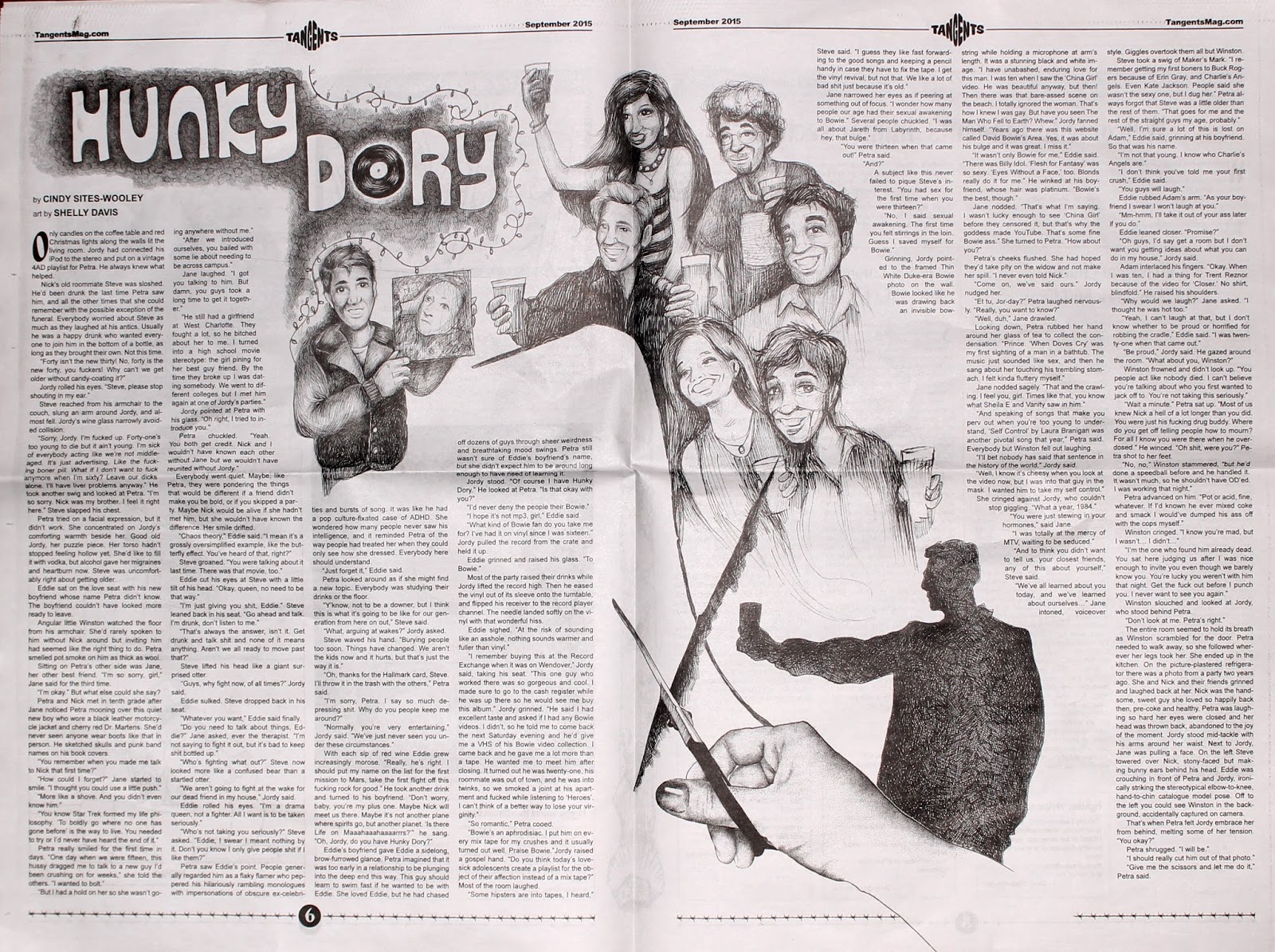


Subscribe to:
Posts (Atom)